
News Release
Personal Income and Outlays, March 2026
Personal income increased $149.2 billion (0.6 percent at a monthly rate) in March, according to estimates released today by the U.S. Bureau of Economic Analysis (BEA). Disposable personal income (DPI)—personal income less personal current taxes—increased $142.5 billion (0.6 percent), and personal consumption expenditures (PCE) increased $195.4 billion (0.9 percent).
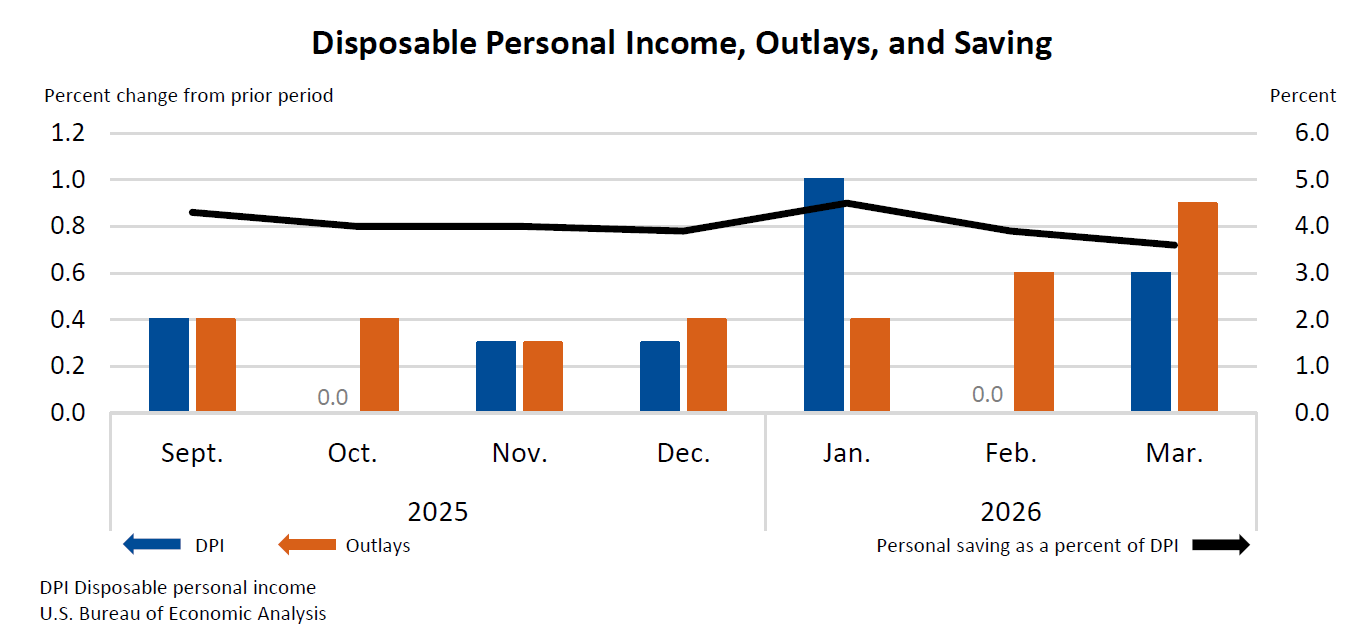
Personal outlays the sum of PCE, personal interest payments, and personal current transfer payments—increased $198.6 billion in March. Personal saving was $857.3 billion in March, and the personal saving rate—personal saving as a percentage of DPI—was 3.6 percent.
The increase in current-dollar personal income in March primarily reflected increases in compensation and farm proprietors’ income that were partly offset by a decrease in other government social benefits.
The $195.4 billion increase in current-dollar PCE in March reflected increases of $132.6 billion in spending on goods and $62.9 billion in spending on services.
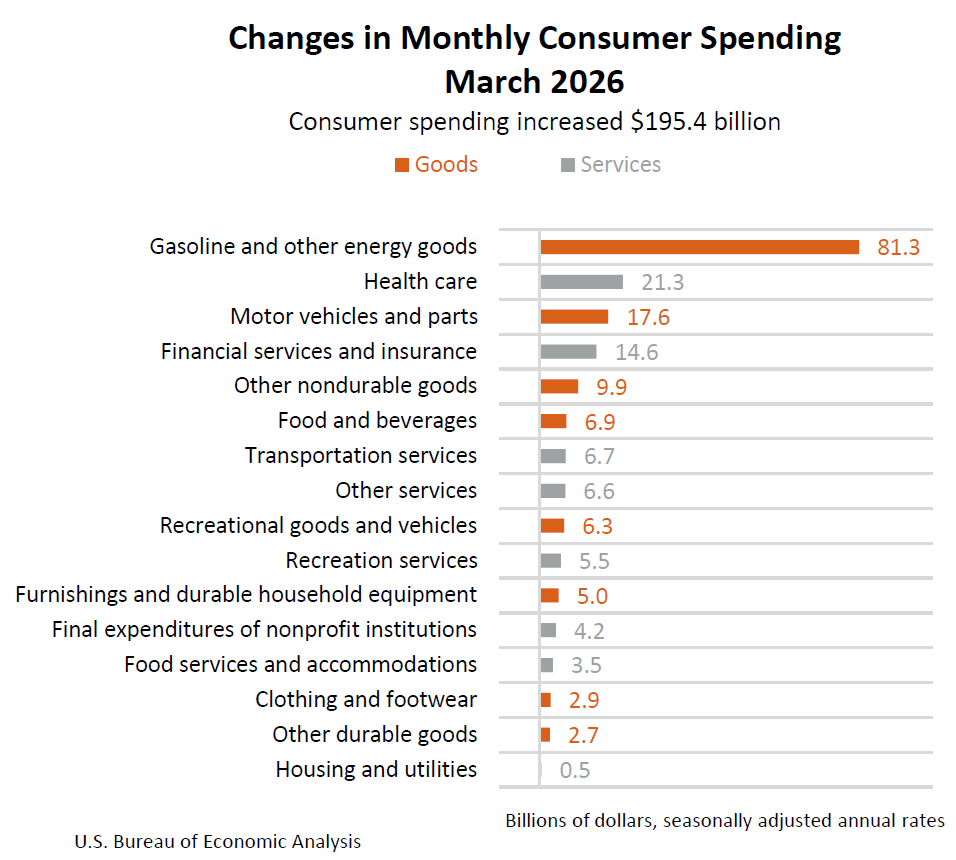
Real PCE increased $39.6 billion (0.2 percent at a monthly rate) in March.
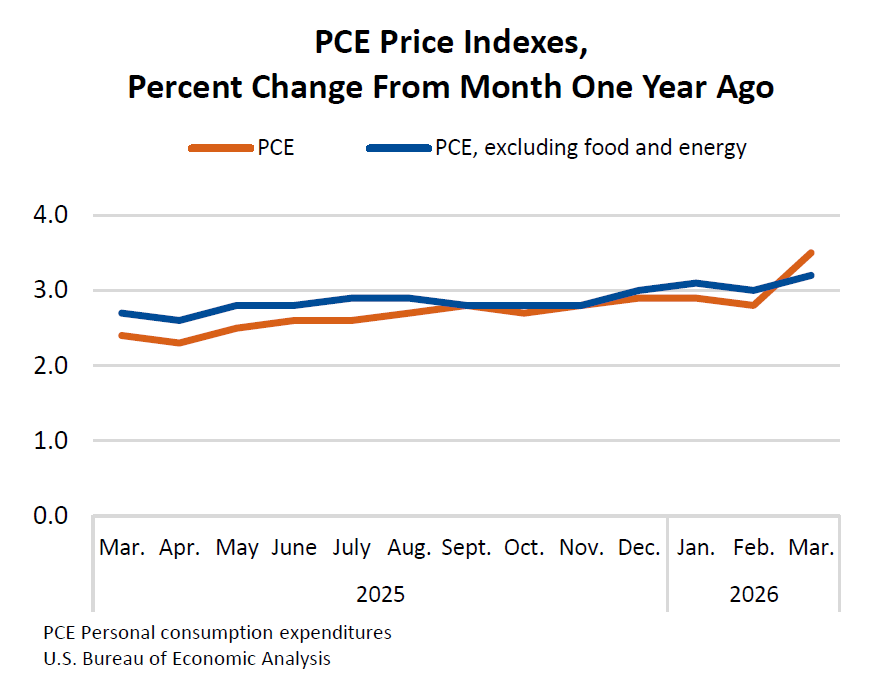
From the preceding month, the PCE price index for March increased 0.7 percent. Excluding food and energy, the PCE price index increased 0.3 percent.
From the same month one year ago, the PCE price index for March increased 3.5 percent. Excluding food and energy, the PCE price index increased 3.2 percent from one year ago.
| Personal Income and Related Measures | ||||
|---|---|---|---|---|
| February | March | |||
| Current-dollar personal income | 0.0 | 0.6 | ||
| Current-dollar DPI | 0.0 | 0.6 | ||
| Real DPI | -0.4 | -0.1 | ||
| Current-dollar PCE | 0.6 | 0.9 | ||
| Real PCE | 0.3 | 0.2 | ||
| PCE price index | 0.4 | 0.7 | ||
| PCE price index, excluding food and energy | 0.4 | 0.3 | ||
Next release: May 28, 2026, at 8:30 a.m. EDT
Personal Income and Outlays, April 2026
Technical Notes
Changes in personal income and outlays for March
The March increase in personal income primarily reflected increases in compensation and farm proprietors’ income that were partly offset by a decrease in other government social benefits.
- Within compensation, the increase was led by private wages and salaries based on Bureau of Labor Statistics (BLS) Current Employment Statistics (CES).
- The increase in farm proprietors’ income reflected payments to farmers from the Farmer Bridge Assistance Program.
- The decrease in other government social benefits reflected a decrease in estimated Affordable Care Act enrollments.
Legal services prices
The PCE price index for legal services was adjusted for the months of January and March. No adjustment was made for February. For more information on why BEA sometimes adjusts source data, refer to the FAQ "Does BEA adjust source data that are used to estimate GDP and related measures?".
Revisions to personal income
Estimates have been updated for January and February, reflecting updated and new data on Medicaid benefits from the Centers for Medicare and Medicaid Services.
Related Data Tables
For the statistics highlighted in this release, as well as historical time series for these estimates, see the following data tables in BEA’s Interactive Data Application.
Table 2.6. Personal Income and Its Disposition
Table 2.8.1. Percent Change From Preceding Period in Real PCE by Major Type of Product
Table 2.8.5. PCE by Major Type of Product
Table 2.8.6. Real PCE by Major Type of Product
Table 2.8.7. Percent Change From Preceding Period in Prices for PCE by Major Type of Product
Table 2.8.11. Real PCE by Major Type of Product: Percent Change From Month One Year Ago
Note. With the next release of PIO, today’s data will be superseded, and the links above will reflect the latest data. The original data featured in this release can then be accessed in BEA’s Data Archive.